Waste management / SDG 3.9, 6.3, 12.4, 12.5 /
Waste handling in KPO is focused on reducing real and potential hazards that production waste, generated by the Company may pose to people and the environment.
Our target is to treat and recycle waste at our facilities, cut down waste transfer to landfills, reduce negative impact from burials, as well as to research and apply new methods and technologies.
As per the working monitoring program, KPO performs regular production environmental control (PEC) over the environmental conditions at the waste burial and accumulation sites in the field.
In 2024, the monitoring did not reveal direct negative effects on the environmental components. As part of the PEC, quantitative control is exercised over the movement of wastes to account for the burial volumes, as well as the volumes and time of waste accumulation. / GRI 306-1 /
The results of our work to minimize the risks of the Company’s production waste impact on the environment are presented below in the table and further in the text.
KPO processes related to production, processing and transportation of raw materials, as well as the use of special equipment, materials and other required resources, inevitably involve generation of waste.
Measures taken by KPO to reduce the volume of generated waste, to ensure compliance with environmental safety rules during the accumulation, collection and transportation, segregation, reuse, recycling, treatment and reduction of waste, including reducing their hazardous properties, as well as environmentally friendly burial – all this enables to significantly mitigate the adverse impact on people and the environment. / GRI 3-3, 306-1 /
Tab. 44. Targets in waste management / GRI 3-3, SDG 12.4, 12.5 /
|
Our 2024 targets |
Target achievement status |
Actions taken in 2024 |
Targets for 2025 |
|---|---|---|---|
|
Ensure implementation of activities scheduled for 2024 as per KOGCF Waste Management Program, and as per the Waste Management Programs for Bolshoi Chagan OPS and Atyrau OPS. |
Completed |
All activities scheduled for 2024 in line with the Waste Management Program were implemented throughout the year. |
Ensure implementation of activities scheduled for 2025 as per the KOGCF Waste Management Program, and as per Bolshoi Chagan OPS and Atyrau OPS Waste Management Programs. |
The KPO Waste Management Program for 2024 provides indicators and measures to gradually reduce the accumulated and generated waste volumes and level of hazardous properties. The Company applies the following waste management methods:
- waste recovery to process stream;
- waste treatment at the Eco-Centre facilities;
- waste burial at the Eco-Centre facilities;
- waste handover to specialist contractor organizations for further processing, reuse or destruction. / OG7 /
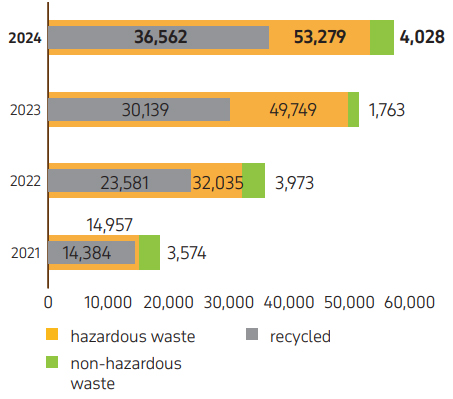
In 2024, the total amount of waste generated at KPO facilities was 58,124 tonnes. Compared to 2023, the volume of waste in 2024 in KPO increased by 5,737 tonnes, which was mainly due to the increase of well operations, and the new development projects. Graph 26 shows all types of waste generated in KPO.
According to the Unified Republican Form of the waste information reporting system, the total volume of waste generated in 2024 included both wastes generated and treated.
Graph 27. Quantity оf waste generated at KPO facilities in 2021–2024, tonnes/ GRI 306-3 /
Waste processing and burial / GRI 306-2, 306-4, 306-5 /
The Company production and consumption wastes are treated at the Eco-Center facilities or the waste management complex. The facility ensures cost-efficient and environmentally safe recycling and treatment of solid waste and fluids and is considered to be an example of the best drilling waste management practice in the West-Kazakhstan Oblast.
Drilling wastes are treated by means of technologies, which allow not only reducing their volume and hazards, but also recovering valuable components from them, and treating the waste for further reuse. Waste recycling back into production process exercised by the Company is the best possible way to re-use the generated waste. The KPO Eco-Centre comprises five waste treatment facilities, as well as a Landfill for its safe disposal.
During 2024, all Waste Management Program (WMP) measures scheduled for 2024 including waste segregation, reuse, processing and reduction of their quantities and hazardous properties, were implemented throughout the year. During 2024 the following activities were implemented at the Eco-Centre:
Tab. 45. Eco-Centre facilities and recycling activities in 2024
|
Eco – Centre Units |
Waste treatment activities in 2024 |
|---|---|
|
Thermo-mechanical Cutting Cleaning facility (TCC) |
Owing to recovery technology of base oil and water from the treated oil-based drill cuttings, in 2024 the quantity of KPO buried waste was reduced by 18 %. |
|
In 2024, 16,132 tonnes of waste were treated; 1,819 tonnes of base oil and water were separated. |
|
|
General Purpose Incinerator (GPI) |
Resulting from waste incineration in the GPI, quantity of waste was reduced by 88 %. In 2024, 634.733 tonnes of waste were sent for incineration, following which 73.44 tonnes of ash were buried at the Eco-Centre Solid Industrial Waste Landfill. |
|
Liquid Treatment Plant (LTP) |
In 2024, 11,425 tonnes of liquid waste were treated. The process resulted in 10,888.42 tonnes of treated brines and muds, which were sent for re-use – preparation of drilling brines and muds. |
|
Waste Segregation Unit (WSU) |
In 2024, out of 867.417 tonnes of solid domestic waste, 525 tonnes were sent to General Purpose Incinerator for incineration, 117 tonnes, including waste paper, metal scrap, glass and plastic were sorted for handing over to the specialist organizations for treatment and reuse. 115 tonnes of solid domestic waste was handed over to specialized organizations for burial at the SDW Landfills. 242 tonnes of food waste was handed over to specialized organization for composting. |
|
Solid Industrial Waste Landfill |
At the end of 2023, 16 cells of the Solid industrial Waste Landfill were capped and closed. |
In 2024, the Company continued to excavate wastes from the old Solid Waste and Spent Drilling Fluids Storage Site for further treatment at the Rotary Kiln Incinerator and burial at the Solid Industrial Waste Landfill. The waste is buried at the Landfill in compliance with the Rok environmental legislation.
In 2024, 3,538 tonnes were sent for treatment from the Solid Waste and Spent Drilling Liquids Storage Site. Processing of waste from the old Site is planned to continue in 2025. / GRI 306-4 /
Table 46 shows the waste handling methods used by the Company in 2024.
Tab. 46. KPO waste handling methods in 2024, tonnes / GRI 306-3, 306-5 /
|
# |
Waste handling method |
Generated hazardous waste |
Generated non-hazardous waste |
Municipal waste |
TOTAL |
|---|---|---|---|---|---|
|
1 |
Availability at the enterprise as at the beginning of 2024 |
364,798 |
23 |
23 |
364,844 |
|
2 |
Generated during the reporting year |
53,279 |
4,028 |
817 |
58,124 |
|
3 |
Reused at the enterprise |
4,491 |
568 |
0 |
5,059 |
|
4 |
Treated at the enterprise facilities |
36,297 |
264 |
765 |
37,326 |
|
5 |
Incineration in General Purpose Incinerator (without energy recovery) |
0.094 |
0.019 |
634.6 |
634.7 |
|
6 |
Burial at Solid Industrial Waste Landfill |
22,404 |
6 |
0 |
22,410 |
|
7 |
Temporary storage of drilling liquid waste in Cells #35 A/B of Eco-Centre |
5,570 |
0 |
0 |
5,570 |
|
8 |
Handed over to specialized contractor organizations |
1,405 |
2,986 |
204 |
4,595 |
|
9 |
Availability in the enterprise as of end of 2024 |
380,203 |
235 |
1 |
380,439 |
The KPO waste is mainly produced during well drilling and workover activities. Whereby, depending on the type of the drilling mud used, the water or oilbased drill cuttings are generated. The solid and liquid drilling waste generated in 2024 amounted to 29,739 tonnes (79 % of the initially generated waste, i.e., waste volume before treatment). Drilling waste volumes were significantly increased due to the growth of well operations.
Table 47 shows the main types of drilling waste broken down by handling methods. As table shows, only water-based muds and brines are subject to disposal at the Eco-Centre cells 35 A/B, and the water-based drill cuttings to be buried at the Landfill. Oil-based drilling cuttings are subject to burying after pre-treatment and extraction of the oil base. / GRI 306-5 /
Tab. 47. Waste generated from well operations by handling methods, 2021–2024 / OG7 /
|
# |
Type of waste |
Generated waste, tonnes |
Handling methods |
||
|---|---|---|---|---|---|
|
2024 |
2023 |
2022 |
|||
|
1 |
Spent water-based drilling mud |
53 |
579 |
1,154 |
Treatment at Liquid treatment plant (LTP) |
|
4,869 |
3,873 |
3,467 |
Temporary storage of drilling liquid waste (in Cells #35 A/B of Eco-Centre) |
||
|
2 |
Water-based drilling cuttings |
2,295 |
1,369 |
2,716 |
Burial |
|
0 |
98 |
0 |
Temporary storage of drilling liquid waste (in Cells #35 A/B of Eco-Centre) |
||
|
0 |
223 |
0 |
Treatment at Liquid treatment plant (LTP) |
||
|
3 |
Spent oil-based drilling mud |
1,749 |
2,596 |
1,257 |
Treatment at the Thermo-mechanical Cutting Cleaning facility (TCC) and Liquid Treatment Plant (LTP), heat treatment in the Rotary Kiln Incinerator (RKI) |
|
56 |
0 |
0 |
Handover to the specialized organizations |
||
|
4 |
Oil-based drilling cuttings |
16,634 |
15,779 |
5,760 |
Treated at the TCC with extraction of oil base, water and followed by the burial of the solid part, heat treatment in Rotary-Kiln Incinerator |
|
5 |
Spent brines |
3,392 |
2,931 |
3,022 |
Treatment at TCC and LTP, heat treatment in Rotary-Kiln Incinerator |
|
597 |
503 |
155 |
Temporary storage of drilling liquid waste (in Cells #35 A/B of Eco-Centre) |
||
|
6 |
Oil cuttings |
0 |
19 |
21 |
Heat treatment in the Rotary Kiln Incinerator, treatment at TCC |
|
94 |
0 |
0 |
Handover to the specialized organizations |
||
Within the contract terms, the Company hands over part of the waste for recycling to specialized contractors, who make their own decision on further waste handling methods once the waste has been accepted from KPO, and report on its transfer to third parties on a quarterly basis. Depending on the type, specialized enterprises hand over the waste for treatment with subsequent production of consumer goods, demercurization, regeneration, thermal treatment, incineration, physical and chemical treatment, dismantling into component parts with further transfer to concerned enterprises as recyclables.
Based on Article 301 of the Rok Environmental Code that prohibits burial of waste plastic, plastic, polyethylene and polyethylene terephthalate packaging, waste paper, cardboard, paper waste, glass cullet at the Landfills, the Company carries out sorting and segregation of such waste engaging contractors that lease office buildings to the Company. These types of waste are then handed over to specialized enterprises to be used as recyclables. / GRI 306-4 /
For the whole period of the waste paper segregation from 2011 till the end of 2024, 1,000 tonnes of the waste paper had been collected and handed over to local enterprises to produce consumer goods.
The segregation of spent batteries was arranged in all company office premises. In 2024, 112 kg of batteries was collected. / GRI 306-4 /
Food Waste Treatment / GRI 306-4 /
In order to comply with the requirements of the Rok Environmental Code, during 2021–2022 KPO has implemented the most efficient way to handle food waste generated at the food facilities of the Karachaganak Field. The contract was signed for the biocomposting of food waste. In 2024, the Company handed over 337 tonnes of food waste from the food facilities of the Karachaganak Field to the food waste processing enterprise. The resulting biocompost is used in agriculture and forestry as organic fertilizers to restore and improve soil fertility.
/ GRI 3-3 /
If handled unsafely, hazardous production waste, and its storage and burial sites, pose threat to the environment and cause pollution of air, underground and surface waters, soil and vegetation, which may have a negative impact on the environment and the health of people.
KPO carries out complex work to prevent negative impact on the environment, i.e. carries out burial and accumulation only in the arranged waste storage sites, monitors the prevention of excess burial and accumulation of waste, as well as the timely removal of waste from accumulation sites.