Asset Integrity / GRI 3-3, 403-2, 403-7, SDG 3.9, 8.8 /
KPO monitors potential threats to its operations and mitigates Asset Integrity risks through its barrier management system. The Asset Integrity department together with the Units continuously assess the health status of the safety barriers to identify weaknesses, implement mitigating measures and establish plans to re-instate these barriers to its original design to prevent any major accident.
The Asset Integrity Management Framework is a set of processes to prevent major accident hazards and to raise Asset Integrity and Process Safety awareness amongst the KPO employees, contractors and subcontractors working at the Karachaganak field.
The Asset Integrity Framework Management System consists of the following key processes:
- Barrier Management – through the application of a structured process supported by the using of the Barrier Model tool;
- Asset Integrity Performance Analysis – through the use of Key Performance Indicators;
- Management of Change system for Brownfield Modifications – through the use of the Management of Change database;
- Asset Integrity Assurance – through the use of reviews, audits, verifications and assessments;
- Asset Integrity Improvement Culture initiatives – through the production of e-Learning modules on the Mechanical Isolation Procedure, Process Safety Fundamentals and the Barrier Management process. / GRI 2-25 /
In 2024, KPO Asset Integrity department has been working on further enhancement of the Barrier Model software at operational facilities/units in terms of their ownership of the BM and its and integration with other software applications. A Cumulative Risk Assessment methodology was developed and introduced to address these. Monthly BM review meetings with units were exercised. Training of newcomers has been continued.
In order to minimize Asset Integrity risks, a number of targets were defined for 2024. The results of the implementation are presented in the table.
Tab. 4. Targets in Asset Integrity / GRI 3-3, 403-2, 403-7 /


|
2024 targets |
Target achievement |
Actions taken in 2024 |
Targets for 2025 |
|---|---|---|---|
|
Completed |
|
|
|
Ongoing |
|
|
|
Completed |
|
|
|
Completed |
|
|
|
Completed |
|
|
|
Completed |
|
|
|
Completed |
|
|
|
Ongoing |
|
|
|
Completed |
|
|
Loss of Primary Containment / GRI 403-2 /
According to KPO requirements, all Loss of Primary Containment (LoPC) Process Safety Events (PSE) were identified, analysed, categorized and followed up by corrective actions to prevent re-occurrence. / GRI 2-25 /
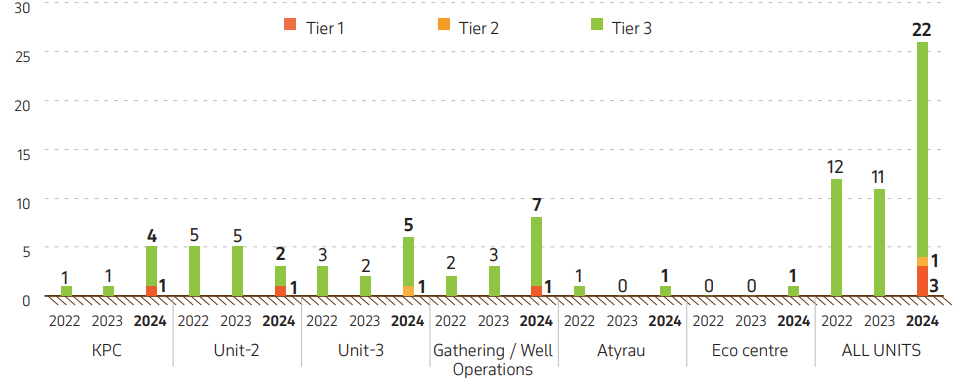
In 2024, the number of Process Safety Events (PSE) has increased compared to 2023. Tier-1: 3 PSEs, Tier-2: 1 PSE and Tier-3: 22 PSEs, in total 26 PSEs occurred during 2024.
The 2024 Tier-1 had 3 PSEs:
- The Dry gas seal struck the hand of Contractor employees at Unit-2. Both workers visited Unit-2 Medical Sick Bay where they were rendered the first aid. After that, one worker was sent to Aksai hospital for X-ray and further examination. Another worker returned to his job duties.
- Gas and condensate release occurred of Well’s flowline at Gathering. The contracting company was performing preparatory works for the repair of pipeline related to replacement of its defective part. No injuries were reported.
- Gas leak was detected on the Pressure Safety Valve line at KPC. There was no activation of gas detectors, no plant shutdown and evacuation of personnel. Desalter was stopped, isolated and depressurized.
One Tier-2 PSE occurred at Unit 3. General gas alarm went off as a result of H2S detectors activation. All Unit 3 personnel were evacuated to the muster points. No injuries were reported.
For all process safety events, KPO conducts investigations, root cause analyses and develops action plan. / GRI 2-25 /
Graph 1. Loss of Primary Containment at KPO by process facilities, 2022 – 2024/ OG13 /
In 2024, KPO has undertaken a number of activities addressing the key risks or barriers, including process containment and remediation of risks. / GRI 2-25 / Amongst those were Process Containment remedial works and replacement of some equipment. 20 Barrier Model risks were resolved – 1 high risks, 13 medium and 6 risks were closed. The activities were focused on ensuring BM risk records have effective mitigations and have effective recovery plans in place. Training and coaching of operational staff in the use of Barrier Model application is ongoing.
In 2025, the following key activities are planned on Barrier Management process:
- Continue conducting Unit BM pre-meetings with Unit focal points and monthly Unit BM meetings as per 2025 schedule;
- Continue verification of the effectiveness of mitigation measures and recovery plan implementation;
- Support BM integration for upcoming new projects;
- Continue staff training and awareness; organize BM roll-out sessions and BM e-learning for new-comers or staff new in their role;
- Support the closure of BM risks and recording the new Unit BM risks;
- Strengthen the Barrier Management process. Integrate BM risks identified from compliance assurance activities of key processes and risks associated with operational integrity critical processes;
- Promote, motivate and coach Units in the usage of BM Dashboard and Asset Integrity / Process Safety dashboards.
Spills / GRI 306-3 (2016) /
In 2024, no cases of significant spills1 were recorded at the territory of the Karachaganak field.
1 The definition of a significant spill is applied to an incident, which has caused contamination of the environment through hydrocarbon/chemical spills to land or water and volume of spilled hydrocarbon/chemical exceeding 1,000 litres (as per KPO Incident classification).
/ GRI 3-3 /
The main objective of Asset Integrity is to prevent major accidents and reduce the risks to people, environment, assets, and the Company’s reputation. It is an outcome of good design, construction, operating and maintenance practices.
Asset Integrity is achieved when facilities are structurally and mechanically sound and perform the processes to produce the products for which they were designed. Barriers that relate to the plants, people and processes are defined to reduce the risk for a major accident to a level that is as low as reasonably practicable.